Raw vs cooked calories: which weight should you log?
Raw vs cooked calories explained: why cooking changes food weight but not energy, with clear rice, pasta, meat, and vegetable examples.
“Should I weigh food raw or cooked?” is probably the most practical calorie-tracking question nobody answers clearly.
Here is the answer: weigh it raw when you can. If you weigh it cooked, log a cooked-food entry. Never mix the two.
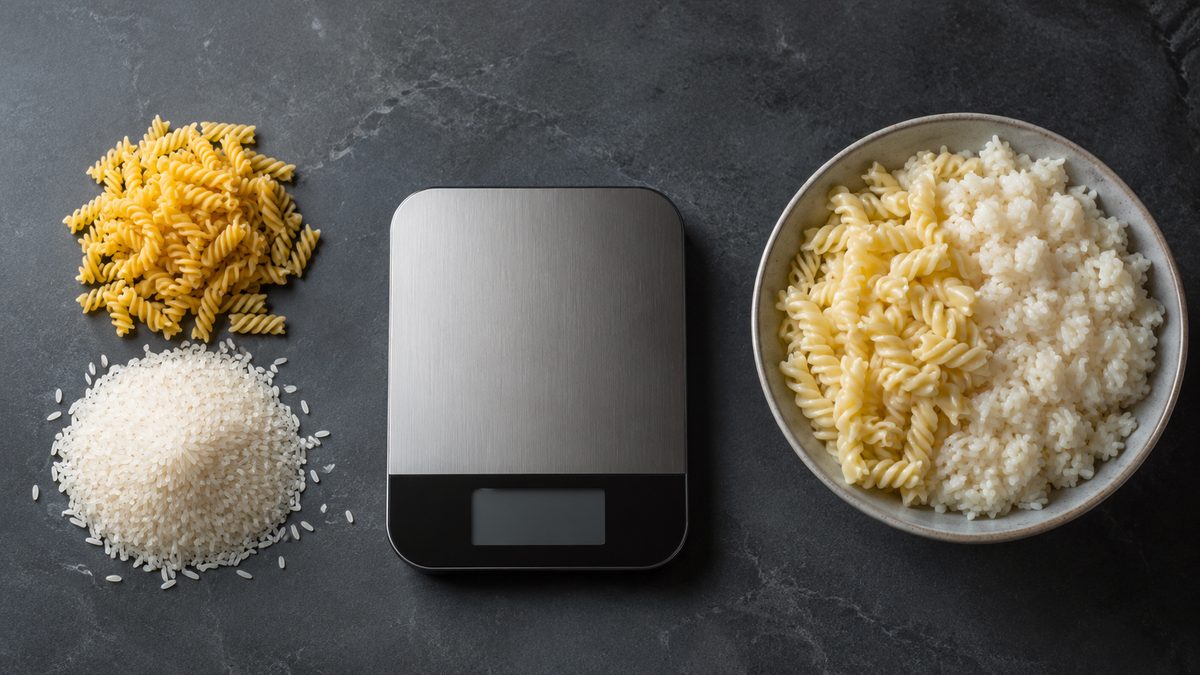
Cooking usually does not create or destroy calories. It changes water. Pasta and rice absorb it; meat loses it; vegetables can do either depending on method. That means 100 g on the scale is not a meaningful calorie measure until you know whether it is dry, raw, boiled, roasted or fried.
This is why food databases can look contradictory. The USDA FoodData Central can list both raw and cooked forms of the same food because they are different weights and therefore different per-100-g values. They are not competing versions of reality.
The rule that prevents nearly every mistake
Match all three things:
- The state: raw, dry, cooked, drained, baked, grilled or fried.
- The food: the actual cut, product or recipe.
- The unit: grams, not a vague “serving” if you can avoid it.
If your kitchen scale shows 75 g of dry pasta, search “dry pasta” or use the packet’s dry values. If it shows 180 g of cooked pasta, use “pasta, cooked.” Logging 180 g cooked as 180 g dry pasta can turn a normal serving into a fictional mountain of calories. Logging dry pasta as cooked does the opposite.
Before fine-tuning a deficit with a calorie calculator, get the state right.
Water changes density, not energy
Imagine 100 g of dry pasta containing roughly 350 kcal. Boil it and it may weigh 220–250 g after absorbing water. The whole cooked portion still contains roughly 350 kcal, because water brought no energy with it. Per 100 g, cooked pasta therefore looks much lower in calories.
Meat reverses the direction. A 200 g raw chicken breast might lose 40–60 g of water while cooking. It still contains broadly the calories it started with, minus any fat that actually renders out or oil you add. Its cooked weight is smaller, so calories per 100 g look higher.
Vegetables follow the same principle: steamed broccoli changes little, roasted courgette loses water, and fried aubergine gains calorie-dense oil.
| Food and starting amount | What cooking does | Approximate cooked weight | What to log |
|---|---|---|---|
| 75 g dry pasta | Absorbs water | 170–190 g | 75 g dry pasta or 180 g cooked pasta |
| 70 g dry rice | Absorbs water | 180–220 g | 70 g dry rice or the cooked weight as cooked rice |
| 200 g raw chicken breast | Loses water | 140–160 g | 200 g raw chicken or cooked chicken weight |
| 250 g raw lean beef | Shrinks and may lose fat | 170–200 g | Match raw/cooked entry; include fat/oil separately |
| 200 g raw broccoli | Minor water change | 170–210 g | Raw or cooked entry, consistently |
| 200 g raw aubergine + 15 g oil | Water leaves; oil is absorbed | Variable | Vegetable plus all oil used/retained |
Rice and pasta: the common trap
When cooking one portion
When batch cooking
Weigh all dry ingredients and record their calories. Weigh the finished cooked batch. Then portion it by cooked weight.
For example, 300 g dry rice at 360 kcal per 100 g contains 1,080 kcal. If the finished pot weighs 900 g, each cooked gram represents 1.2 kcal; a 150 g serving is 180 kcal. You do not need to find a mystical “perfect cooked rice” entry because you have the actual recipe.
This same batch method is the reliable answer for soups, curries and family dinners. Our guide to logging a homemade recipe walks through the arithmetic without pretending a stew can be reduced to one barcode.
Meat: shrinkage is not calorie loss
Take a raw 200 g chicken breast. After cooking it could weigh 150 g. If you log 150 g using a raw-chicken entry, you undercount the original piece; if you log 200 g using a cooked entry, you overcount. Either route can work, but the weight and entry must belong together.
Vegetables, sauces and “zero-calorie” assumptions
Raw versus cooked entries matter less for watery vegetables than for dry pasta, but they still matter. More importantly, methods matter. A 200 g pile of steamed courgette is not nutritionally comparable to 200 g of courgette roasted in oil and topped with cheese.
Do not let precision become selective: oil usually matters more than a few grams of broccoli. For restaurant meals, learn how to estimate calories at restaurants, not how to carry a scale to dinner.
A simple workflow that survives real life
- Weigh raw ingredients for meals you cook yourself.
- Use the label for packaged foods whenever it is available; it describes that product.
- For batch meals, log the ingredients and divide by cooked portions or total cooked weight.
- When someone else cooked, weigh the served cooked food and choose a cooked database entry.
- Record oils, butter, dressings and sauces deliberately.
Consistency beats theatrical accuracy. Use one method, match the database state, and your trend can tell you whether your intake estimate is working.
This article is general information, not medical advice. Nutrition labels and database values are estimates; follow food-safety guidance and seek individual advice from a registered professional where needed.

Are you matching the weight on your scale to the database entry you log?
Track your meals with AI — snap a photo and get instant calories and macros.
Try Tabeku Free