How to log a homemade recipe without guessing servings
Learn how to log a homemade recipe by weighing raw ingredients and your finished portion, with a practical lentil stew example.
“One serving” is one of the least useful phrases in calorie tracking.
It sounds precise, but a serving of a pot of lentils can mean a small bowl, a deep plate, or the generous scoop you take after a long day. Recipes online usually divide a dish into four or six equal portions because the writer needed a number. Your body does not eat the writer’s number.
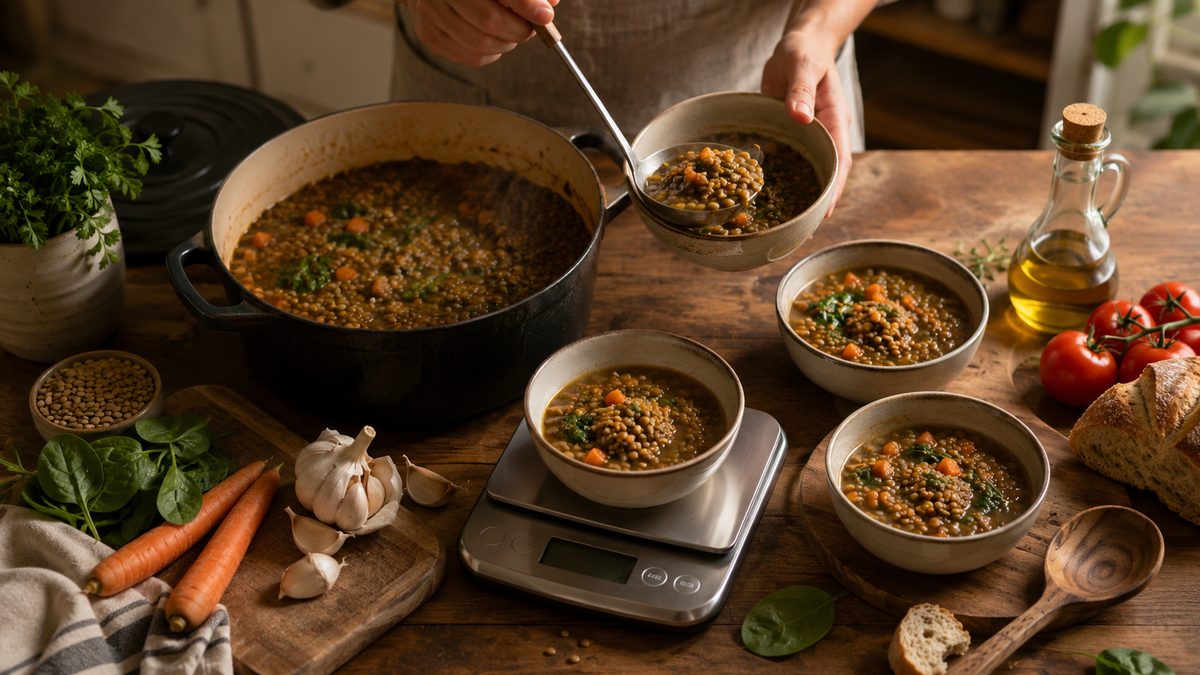
The practical way to log a homemade recipe is simpler: weigh every ingredient before cooking, weigh the finished pot, then log the weight you actually put on your plate. It works for stews, curries, chilli, lasagne, paella, and anything else where “one serving” is a fiction.
If you are unsure whether an ingredient belongs in the total, start with the same rule used for raw versus cooked calories: calories belong to the food you bought and used, not to the water it later gains or loses.
Why recipe servings are a bad unit
Servings answer a social question — how many people might this feed? They do not answer a nutritional one. A 900 g finished dish split into four has 225 g per serving; split into six it has 150 g. The pot has not changed. Only the label has.
Grams solve this. Once the entire cooked dish has a known calorie total, each gram has a known share of that total. Your portion can be 180 g, 342 g or 517 g; the calculation still works. You do not need to decide whether it was a large serving. You just need the scale.
This removes the big avoidable guess: arbitrary portions. For complex family dishes, see tracking complex stews without losing the plot.
The method: weigh the pot, then your plate
1. Log ingredients as they go in
Weigh each calorie-containing ingredient in its raw, dry or packaged state. Record the weight and the calories from its label or a credible database. Vegetables matter less than oil, but logging them makes the saved recipe reusable and avoids a collection of small omissions.
2. Add the ingredient calories for the whole recipe
Do this before thinking about portions. The result is the calories in the entire pot. If protein, carbohydrate and fat matter to you, add those too. It is the same logic as using a calorie calculator to establish a daily target: useful arithmetic first, then a decision based on your actual day.
3. Weigh the finished dish, without the pan
Put an empty bowl on the scale and tare it, then transfer the finished food into it; or weigh the pan empty and full and subtract. Write down the final food weight in grams.
4. Weigh your portion
Place your bowl on the scale, tare it and serve yourself. Your logged entry is:
your portion weight ÷ finished recipe weight × total recipe calories
Worked example: a pot of lentil stew
Here is a realistic lentil stew for several meals. The nutrition values are illustrative; use your own packet labels where they differ.
| Ingredient | Raw weight | Calories used | Recipe calories |
|---|---|---|---|
| Dry brown lentils | 300 g | 340 kcal per 100 g | 1,020 kcal |
| Chicken thigh, trimmed | 400 g | 170 kcal per 100 g | 680 kcal |
| Olive oil | 20 g | 9 kcal per g | 180 kcal |
| Onion | 180 g | 40 kcal per 100 g | 72 kcal |
| Carrot | 200 g | 41 kcal per 100 g | 82 kcal |
| Tomato passata | 500 g | 29 kcal per 100 g | 145 kcal |
| Whole pot | — | — | 2,179 kcal |
After simmering, the food in the pot weighs 2,350 g. That means each gram contains about 0.93 kcal: 2,179 ÷ 2,350 = 0.927.
You serve yourself 380 g. Your entry is 380 × 0.927 = 352 kcal. Someone else takes 540 g: their bowl is about 501 kcal. Neither person has to argue about what a serving is.
If you prefer per-100-g entries, multiply the calories per gram by 100: this stew is 93 kcal per 100 g. Then a 380 g bowl is 3.8 × 93, again roughly 353 kcal. Rounding one way and using it consistently is enough; pretend precision is not the goal.
Water changes weight, not energy
Evaporation is why raw weight cannot be used as the portion denominator. In the example, some water leaves during simmering. With a soup, you may add enough water that the finished pot weighs more than the ingredients. Either way, the 2,179 kcal have not vanished or multiplied.
Oil deserves the same plain thinking. Oil that ends up in the dish counts. Oil visibly left in the pan or discarded with a marinade does not all end up in your bowl. The most practical approach is to measure the oil you add, then make a reasonable adjustment only when a clearly measurable amount remains behind. Trying to estimate every absorbed gram by sight is where tracking becomes theatre.
Save the recipe for next time
Save it as “lentil stew — 93 kcal per 100 g” or with its whole-pot total and final weight. Reuse it only with the same quantities and method; changing oil, meat or water means updating it.
Log ingredients while cooking, keep the total, and record the plate weight rather than forcing a serving count. The useful habit is repeatable, not perfect.
This article is general information, not medical advice. If you have a health condition or need individual nutrition advice, talk to a doctor or registered dietitian.

Could weighing your bowl be easier than guessing a serving?
Track your meals with AI — snap a photo and get instant calories and macros.
Try Tabeku Free