How to count calories at restaurants and enjoy the evening
Learn how to estimate your macros and calories when eating out. Discover practical strategies and how to log meals later.
Going out for dinner with friends while trying to maintain a calorie deficit doesn’t have to be stressful. You want to enjoy the food and the company, but calculating the macros of a restaurant dish isn’t always easy. It helps enormously to walk in already knowing how many calories your day actually allows, so one meal becomes a number you can absorb instead of a mystery.
How do you keep track of what you eat without making it look like you’re taking a math exam right at the table?
The challenge of estimating calories eating out
Traditional tracking apps are useful when you cook and weigh everything at home. However, at a restaurant, you face three main challenges:
- Unknown amounts: At a glance, it’s hard to calculate the exact weight of a portion. A visual error when estimating carbs or protein can significantly alter your daily log.
- Invisible ingredients: Professional kitchens use higher proportions of fats (oils, butter) to enhance flavor and texture. These extra calories are rarely obvious — and it’s the same trap as logging a food raw when you actually ate it cooked: the entry looks right, the number isn’t.
- Social friction: Searching for a complex dish in a generic database forces you to choose among dozens of unreliable options, distracting you and interrupting your evening.
The Calorie “Buffer” Strategy
A highly effective technique for these occasions is applying a calorie “buffer” or margin to your day. If you know you’re having a large dinner, prioritize eating lean proteins and high-fiber vegetables during breakfast and lunch.
This way, you save a larger portion of your daily carb and fat budget for the evening. This strategy gives you the flexibility needed to avoid compromising your long-term goals. Even so, it’s good to have a realistic estimate of what you end up eating so you don’t overdo it without realizing.
AI Estimation: The power of logging later
The best way to enjoy dinner is to not open any nutrition app while you’re at the table. Tabeku’s artificial intelligence is designed to adapt to your social life, not the other way around.
Our models combine advanced computer vision and natural language understanding to analyze your food (3D volumetric estimation, lipid and texture detection), allowing you to delegate tracking and do it after the fact, when you are relaxed at home:
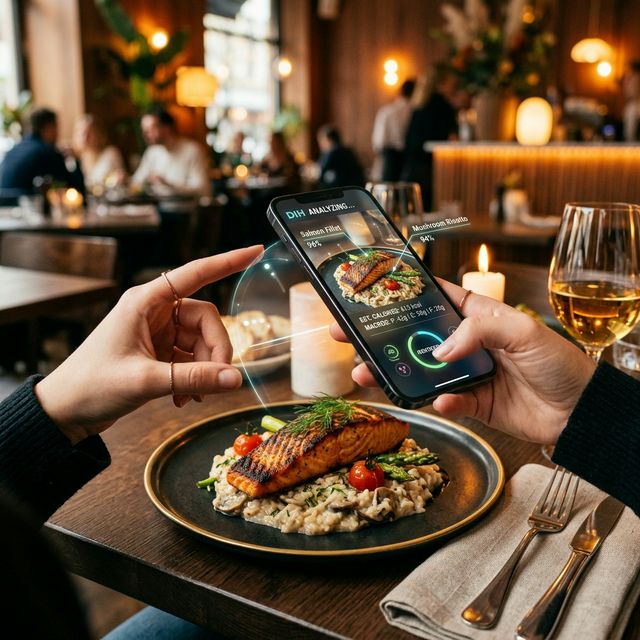
- Using a photo from your gallery: Feel uncomfortable using the app at the restaurant? No problem. Use your phone’s regular camera and take a super quick photo of your dish (you can always say it looks beautiful or it’s for social media) and put your phone away. Hours later, you can upload that photo directly from your camera roll to Tabeku and the AI will break down the calories and total macros in seconds.
- Via text: If you’d rather not take your phone out at the table at all, that’s perfectly fine too. When you get home, just dictate or type a short descriptive text in the app. You can write something like: “I had a huge plate of mushroom risotto, a glass of white wine, and two slices of bread”. Our model will interpret the typical context of restaurant cooking and estimate a realistic nutritional value for your meal.
This technological approach completely eliminates social friction. There are no more excuses to abandon your consistency: focus fully on the people in front of you, enjoy the moment, and let the software handle the nutritional bureaucracy later.

How many calories do you think your last restaurant meal had?
Track your meals with AI — snap a photo and get instant calories and macros.
Try Tabeku Free