What are macros, actually (and why they matter more than you think)
Everyone talks about adjusting their macronutrients... but why? Discover simply what proteins, carbohydrates, fats, and fiber are.
Going to a gym, entering fitness forums, or simply taking an interest in physical well-being on social media means inevitably running into the term “macro.” You’ve likely heard the expression: “I’m hitting my macros perfectly this month” — but what does it actually mean without using boring laboratory jargon?
And, much more importantly, why should you actively care about the exact distribution of these nutrients instead of just counting your total daily calories?
Let’s break it down simply so that, whether you’re a beginner or a veteran, you fully understand the logic and how to apply it to boost your health.
What exactly are “macronutrients”?
“Macronutrients” (which we colloquially abbreviate as “macros”) are the large functional building blocks that make up the foundations of human nutrition. They constitute the raw material our body uses to develop, operate daily, and repair its cellular tissues.
They are called “macro” because their daily requirement is measured on a large scale (grams), as opposed to vitamins or minerals (micronutrients), which act as regulators on a very small scale (milligrams or micrograms).
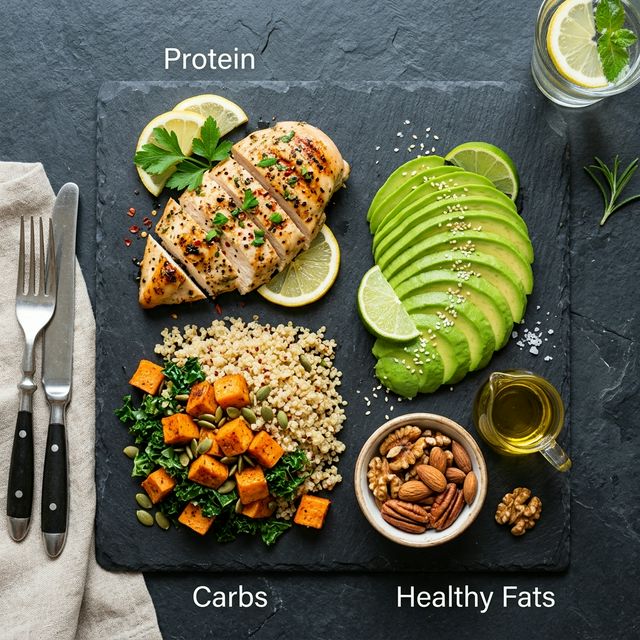
All nutritious foods are composed of combinations of these three essential pillars:
1. Proteins (4 kcal per gram)
Imagine proteins are the “bricks” that build your body’s architecture. If you want to hypertrophy your muscle after strength training, regenerate muscular tears, or simply prevent sarcopenia (progressive loss of fat-free mass) caused by aging, getting enough protein each day is a biological imperative.
Apart from their structural role, eating protein has a very high thermic effect. That is, your body burns more energy (up to 20-30%) from the protein’s own calories just to digest it metabolically in the gastric system. It is for this reason that any meal rich in protein (eggs, meat, white fish, legumes, tofu) provides high rates of prolonged satiety.
2. Carbohydrates (4 kcal per gram)
If proteins are your bricks, carbohydrates function unequivocally as your main motor “fuel”.
They provide the exact same base caloric energy as their peers (4 pure kilocalories), however, their absorption and destiny are markedly different. When you eat potatoes, brown rice, a plate of fruit, or oats, the body breaks them down into assimilable glucose. That glucose flows in the blood or is quickly stored in your muscles and hepatic tissue as glycogen. It is your premium gasoline, sparking to respond during high-intensity workouts or activating your complex logical connections in the brain.
Essential note on fiber: There is a key subgroup of carbohydrates called dietary fiber. Your human body lacks the suitable enzymes to digest them completely, so they provide a very low net caloric index, but they sweep away organic waste and feed your intestinal flora, which is key to a healthy immune system.
3. Fats or Lipids (9 kcal per gram)
Here the density paradigm takes a monumental leap. Healthy fats provide a forceful and striking load of 9 kilocalories per gram. This massive concentration, representing more than double the contribution of the other blocks, has been the main historical culprit for the unfounded and irrational fear of avocados or virgin olive oil.
Assuming that eating fats will inevitably make you gain weight is an outright falsehood. This macronutrient directly orchestrates your entire steroidal hormonal machinery and production (like vital stable testosterone or estrogens), solidly protects the soft neuronal envelope, and is the exclusive carrier capable of mobilizing the metabolic absorption of vital fat-soluble vitamins like A, the powerful vitamin D from the sun, the antioxidant E, and the useful K.
(Fun fact: There is an infamous fourth energetic macronutrient that many forget, ethyl alcohol. It provides no less than 7 empty kilocalories per gram of pure toxicological poison, without offering structural or real empirical nutritional support).
Why do they matter beyond calories?
If the first inescapable rule of thermodynamics dictates that the global and net energy balance (total of your calories) will decide whether you gain or lose gross weight on the scale, the distribution of your macros is what truly determines exactly what that weight will be composed of and how you will feel in the arduous process.
- If you abusively cut protein and maintain a severe daily deficit, you will undoubtedly lose kilos, but you will shed a large amount of vital fat-free functional muscle mass from your body, feeling immensely more fragile, slender but flabby, and infinitely weaker at a total real motor level.
- If you aggressively cut your fats, you will drop fast, however, there is a frankly very high natural biological probability of suffering an imminent severe drop in sexual libido or developing incipient depressive episodes at a mental and cognitive level, compromising your entire organic endocrine balance outright.
To achieve the desired aesthetic and functional body, a good technological tool that offers simplicity like Tabeku must not just lazily focus on counting empty and impersonal raw absolute numerical calories; it must help you visually and interactively to organically learn over time the balanced, harmonious, ideal relationship maintained by these three imperative massive blocks in real daily life.

Do you know what the ideal macro ratio for your daily meals should be?
Track your meals with AI — snap a photo and get instant calories and macros.
Try Tabeku Free