Does estimating calories with a photo really work? The science behind Tabeku
We demystify our smart camera. Discover how computer vision and language models are revolutionizing nutritional analysis.
We often receive questions that blend amazement with logical skepticism. Many users, accustomed to nutrition apps of the past, pose a very valid question:
“How can an app know how many calories and macros are in my food just by looking at a photo of it?”
After years of having to manually search for foods and weigh them gram by gram every day, it’s understandable that a visual estimation feature sounds like magic or marketing hype. A formula-based daily calorie estimate is easy to trust because you can follow the arithmetic yourself. A photograph is not, so it deserves a proper explanation.
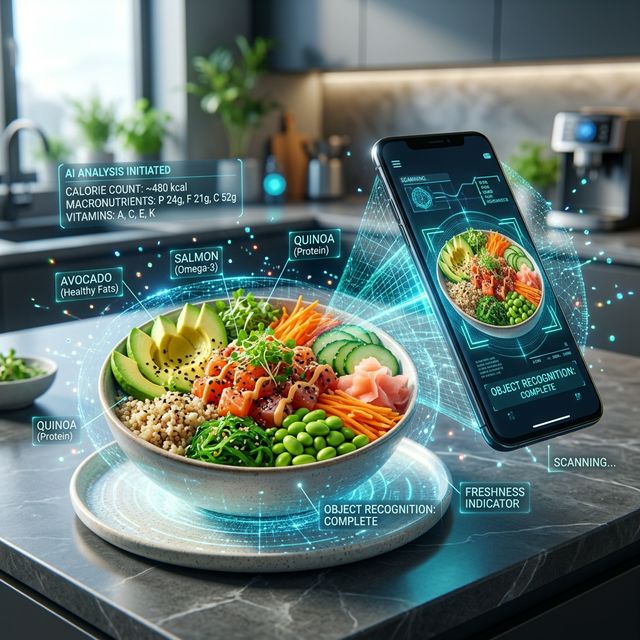
However, what operates every time you press the camera button has nothing to do with magic. It is a technological convergence of computer vision neural networks operating alongside large language models (LLMs).
Below, we’ll break down exactly how this process works from the moment you take the photo until you receive your macronutrients.
The 3 pillars enabling Tabeku’s visual revolution
Making a camera understand nutrition is one of the most useful recent technological milestones. Our system combines several layers of artificial intelligence capable of analyzing complex data in microseconds:
1. Visual ingredient detection and analysis (Computer Vision)
The first step is identifying the components of the dish. However, the system doesn’t settle for simply classifying “meat” or “bread”. The neural networks are trained on millions of images to detect textures, densities, and cooking states.
For example, by analyzing crumb pores and baking shades, it can differentiate a fluffy, butter-rich slice of brioche from dense whole-rye bread. Additionally, the AI examines reflections and visual gloss on foods to discover the presence of added cooking oils. It can determine if a potato is baked naturally, sautéed, or deep-fried, drastically adjusting the estimated caloric impact—the same reason different apps can show different calorie totals.
2. 3D volumetric inferences and perspective
Locating a piece of salmon in a photo is only half the equation; determining how much it weighs is the real challenge. A simple 2D image is not enough to know the depth of food.
By calculating geometric perspective and using universal visual references (like standard cutlery sizing, typical plate diameters, or camera angle), algorithms infer the three-dimensional volume of portions.
The system understands the concept of nutritional density: it knows that a bowl full of spinach leaves takes up a large visual volume but possesses a very low calorie amount, whereas just one large spoonful of peanut butter, occupying a fraction of that visual space, represents ten times the caloric value.
3. Human context through Large Language Models (LLM)
Computer vision algorithms are excellent at recognizing pixels, but they lack human common sense. Therefore, the detected visual data is passed through a large language model (LLM), which provides deep situational and cultural context.
Imagine you take a photo of a classic cardboard takeout container full of Asian noodles. The visual AI will detect “noodles, meat, vegetables”. But the LLM reasons a step further:
“This is a typical container from a commercial fast-food Oriental restaurant. The noodles have a dark glazed appearance suggesting a generous dressing with sweet soy-based sauces and sugars, cooked in a wok with plenty of vegetable oil.”
In this way, the app automatically adds to the structural estimation those “invisible” ingredients (hidden fats, sweeteners, sauce reductions) that conceal the majority of commercially sourced calories—and which are the main cause of fat-loss plateaus.
The key factor: Continuous iterative learning
What makes Tabeku truly powerful compared to a static database is its capacity for iterative learning.
If the AI occasionally interprets your potato purée as hummus (a possible error given their visual similarity), you can intervene and correct the app by saying “No, it’s mashed potatoes”.
The model assimilates this correction in real-time, interacting with you conversationally. It updates the macros of the current log and uses these feedback data points to fine-tune its global accuracy over time.
The ultimate goal: Frictionless consistency
No visual algorithm will be 100% perfect, just as commercial nutritional labeling has legally permitted margins of error up to 20%. Demanding mathematical perfection from a plate of food is a biologically flawed approach.
The true goal of Tabeku’s AI is to reduce the logistical friction of daily logging to zero. By eliminating the boring, slow, and bureaucratic process of counting calories or scanning barcodes, you avoid mental fatigue. And when the process is easy and doesn’t interfere with your social life, you radically multiply your chances of maintaining effective nutritional habits forever.

Can AI accurately calculate the calories of your plate?
Track your meals with AI — snap a photo and get instant calories and macros.
Try Tabeku Free